Top 10 ENT Hospital Management Systems for Healthcare Facilities
Top 10 ENT Hospital Management Systems in India 2026 | Doctors App
Ear, Nose and Throat (ENT) healthcare facilities manage a wide range of medical conditions, diagnostic procedures, consultations and surgical treatments. From routine ear infections and sinus problems to hearing disorders, tonsil conditions and complex ENT surgeries, healthcare providers need an organized system to manage patient information and hospital operations.
Managing an ENT department involves several activities, including patient registration, appointment scheduling, consultation documentation, diagnostic reports, audiometry records, prescriptions, surgery scheduling, billing and follow-up management.
When these activities are handled through disconnected software applications or manual paperwork, hospital staff may face difficulties maintaining accurate records and coordinating daily operations.
This is why ENT Hospital Management Systems (HMS) have become important for modern healthcare facilities.
An ENT Hospital Management System is a digital healthcare platform designed to manage administrative, clinical and operational activities within ENT clinics and hospital departments. It helps healthcare providers organize patient information, streamline consultations, manage appointments and maintain digital medical records.
In India, the growing adoption of digital healthcare solutions has increased the demand for cloud-based and AI-powered hospital management software.
In 2026, healthcare facilities are ooking beyond basic hospital billing systems. They need comprehensive platforms that support EMR, EHR, OPD, IPD, laboratory, pharmacy, digital prescriptions and healthcare administration.
Doctors App is one platform worth considering for ENT healthcare facilities. It offers AI-powered EMR, EHR and HMIS capabilities designed to support individual doctors, clinics, nursing homes and hospitals.
This article explores the top 10 ENT hospital management systems, their important features, benefits and the factors healthcare facilities should consider before selecting a suitable solution.
What Is an ENT Hospital Management System?
An ENT Hospital Management System is specialized healthcare management software used to organize the clinical and administrative operations of ENT departments, clinics and hospitals.
It helps healthcare professionals maintain patient records, manage consultations, generate prescriptions, schedule appointments and coordinate different hospital activities through a centralized digital platform.
ENT specialists regularly deal with different types of medical information, including:
-
Patient registration and demographic details.
-
Ear, nose and throat examination notes.
-
Medical and surgical history.
-
Hearing assessment and audiometry reports.
-
ENT diagnostic investigation records.
-
Medication and prescription history.
-
Allergy and infection information.
-
Endoscopy and procedure documentation.
-
Surgery records.
-
Follow-up consultation details.
-
Laboratory and imaging reports.
A suitable hospital management system helps healthcare facilities maintain these records digitally and access relevant information when required.
Unlike basic appointment software, an ENT HMS can support multiple hospital departments, including reception, OPD, IPD, pharmacy, laboratory, billing and administration.
Why Do ENT Healthcare Facilities Need Hospital Management Software in 2026?
ENT departments handle different clinical procedures and patient requirements throughout the day. Doctors may conduct consultations, review diagnostic reports, perform minor procedures, schedule surgeries and manage postoperative follow-ups.
Without an organized digital system, coordinating these activities can become time-consuming.
Here are some important reasons why ENT clinics and hospitals should consider adopting hospital management software.
1. Centralized Patient Record Management
ENT specialists need access to patient medical histories, previous consultations, diagnosis details and treatment records.
Hospital management software helps maintain these details in digital patient profiles, making information easier to organize and retrieve.
2. Efficient OPD Management
ENT departments often handle multiple outpatient consultations every day. OPD management features help organize patient registration, appointment queues, doctor availability and consultation records.
3. Better Diagnostic Report Management
ENT diagnosis may involve audiometry, tympanometry, endoscopy, imaging and other investigations.
A digital management platform helps maintain uploaded reports and investigation information within patient records.
4. Streamlined Surgery and IPD Management
Hospitals providing ENT surgical services need to manage admissions, operation schedules, patient records, billing and discharge documentation.
An integrated HMS can help coordinate these activities.
5. Digital Prescription Management
ENT specialists prescribe medicines for infections, allergies, sinus conditions, hearing-related complaints and postoperative care.
Digital prescription functionality helps doctors prepare prescriptions and maintain medication histories.
6. Improved Appointment Scheduling
Patients may require multiple consultations for diagnosis, treatment and postoperative reviews.
Appointment management software helps clinics organize consultation schedules and follow-up visits.
7. Reduced Administrative Work
Digital patient registration, billing, prescriptions and medical records can reduce dependence on manual documentation.
8. Better Coordination Between Departments
An integrated hospital management platform helps different teams access relevant information according to their assigned responsibilities.
For larger ENT healthcare facilities, this can support coordination between reception, doctors, nursing staff, laboratories, pharmacy and billing departments.
Top 10 ENT Hospital Management Systems for Healthcare Facilities
Healthcare facilities have different requirements depending on their size, number of doctors, patient volume and available medical services.
The following list highlights hospital management platforms and solution categories worth evaluating in 2026. The order is an editorial shortlist, not an independently verified performance ranking. ENT-specific workflows should be confirmed through a product demonstration.
1. Doctors App – AI-Powered ENT Hospital Management System
Best for: ENT clinics, multispecialty hospitals and healthcare facilities looking for integrated EMR and HMIS software.
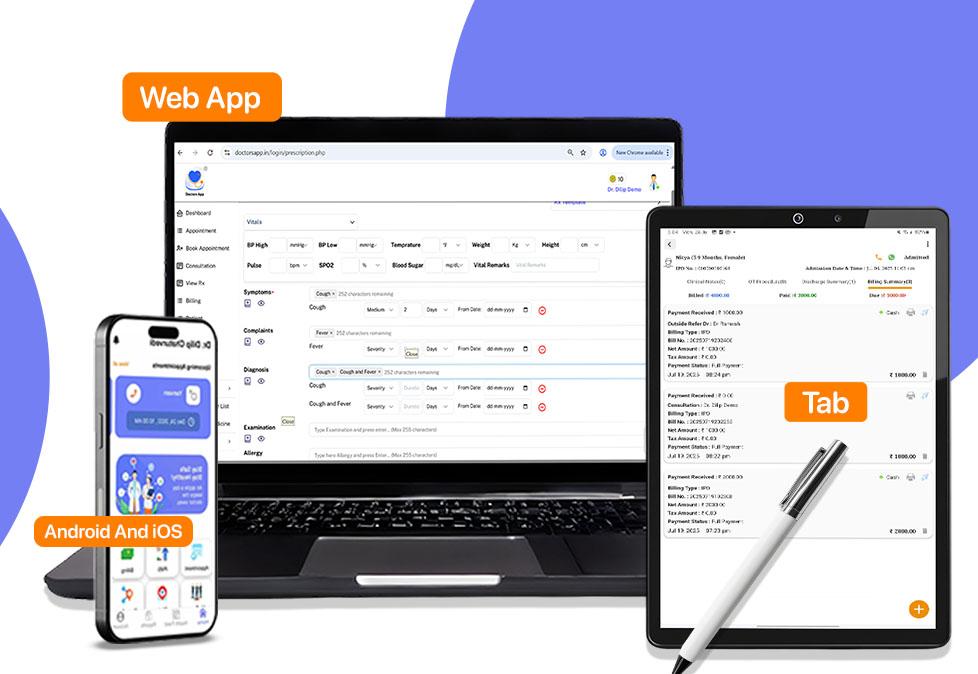
Doctors App is an AI-powered EMR, EHR and Hospital Management System designed to digitize clinical and administrative healthcare operations.
For ENT healthcare facilities, Doctors App provides a centralized platform for managing patient registrations, appointments, consultations, prescriptions, diagnostic reports, inpatient records and hospital administration.
ENT specialists can use its digital medical record capabilities to maintain patient consultation histories and organize clinical documentation.
Key features of Doctors App:
-
Digital EMR and EHR: Maintain patient information, medical histories, diagnoses and consultation records electronically.
-
OPD Management: Manage patient registration, appointments, consultations and daily outpatient activities.
-
IPD Management: Handle patient admissions, ward and bed allocation, nursing notes and discharge documentation.
-
AI-Powered Digital Prescriptions: Generate digital prescriptions in less than 20 seconds.
-
AI Voice to Rx: Support voice-based prescription documentation.
-
AI Investigation Extraction: Extract information from supported laboratory reports and diagnostic documents.
-
Laboratory Management: Organize investigations, sample collection and diagnostic reports.
-
Pharmacy Management: Manage medicine-related operations and pharmacy billing.
-
OT Management: Maintain operation theatre schedules and procedure-related records.
-
Billing Management: Manage OPD and IPD billing, payments and financial records.
-
Multi-Doctor Management: Support multiple doctors and staff members with role-based access.
-
ABDM Integration: Support ABHA-related workflows and FHIR-based digital health records.
-
Cloud-Based Access: Access supported healthcare management features through web, Android and iOS applications.
-
Patient Communication: Support patient engagement and follow-up communication through available integrations.
Why choose Doctors App for an ENT hospital?
ENT hospitals need more than appointment scheduling and prescription software. They require a connected platform that can support the complete patient journey, from registration and consultation to investigations, admission, surgery documentation and discharge.
Doctors App brings multiple healthcare management functions together, helping reduce dependence on disconnected systems.
For example, an ENT hospital can use its EMR functionality to maintain consultation records, its OPD module to organize patient visits, its IPD module for admitted patients and its billing capabilities for financial documentation.
The platform also supports digital prescriptions and AI-powered documentation, which can help doctors reduce repetitive administrative work.
ENT-specific templates for otoscopy, audiometry, tympanometry, nasal endoscopy and laryngoscopy should be evaluated during the demo to confirm suitability for the department's clinical requirements.
Explore Doctors App Hospital Management Software to understand its hospital management capabilities.
2. Sterling Softwares – ENT Hospital Management Software
Best for: ENT hospitals looking for specialty-oriented OPD, IPD and operational management.
Sterling Softwares offers an ENT-focused hospital management solution designed to support the daily administrative activities of ENT healthcare facilities.
Its ENT HMS features include appointment management, multiple doctor management, OPD, IPD, billing, patient information and operation-related modules.
Key features:
-
Multiple doctor management.
-
Appointment scheduling.
-
OPD management.
-
IPD management.
-
Patient information management.
-
Operation module.
-
Billing and receipt generation.
-
Medical certificates and discharge summaries.
-
Patient image and video storage.
-
User management.
Healthcare facilities considering this type of software should evaluate its reporting capabilities, data security, customization options and integration requirements before implementation.
3. NIC e-Hospital – Integrated Hospital Management System
Best for: Hospitals looking for broad hospital workflow digitization.
NIC e-Hospital is an integrated Hospital Management Information System designed to support different hospital departments and administrative workflows.
Although it is not exclusively developed for ENT departments, its hospital-wide modules can be relevant for healthcare facilities operating ENT services.
Key features:
-
Patient registration.
-
OPD appointment management.
-
Admission, discharge and transfer.
-
Billing management.
-
Laboratory information management.
-
Radiology information management.
-
Pharmacy and inventory.
-
OT management.
-
Electronic medical records.
-
Hospital administration.
ENT hospitals can evaluate its departmental workflow capabilities according to their operational requirements.
4. DMediQ – Hospital Management Software
Best for: Healthcare facilities looking for connected hospital and clinical management modules.
DMediQ offers hospital management capabilities covering clinical and administrative activities.
Its platform brings multiple hospital operations into a connected system, making it an option for facilities evaluating centralized patient records and departmental management.
Key features:
-
OPD and appointment management.
-
IPD and bed management.
-
EMR and EHR.
-
Laboratory management.
-
Pharmacy management.
-
Hospital billing.
-
Insurance and TPA workflows.
-
Inventory management.
-
Patient engagement.
-
Hospital analytics.
ENT hospitals should check whether its clinical templates can be configured for their specialty-specific documentation requirements.
5. kNODE – Hospital Information Management System
Best for: Medium and large hospitals requiring multiple integrated departments.
kNODE provides a modular hospital information management platform that covers several clinical and administrative departments.
For healthcare facilities with ENT departments, an integrated HMS can help coordinate patient registration, consultations, inpatient services, diagnostic departments and hospital administration.
Key features:
-
Patient management.
-
EMR and EHR.
-
OPD and appointments.
-
IPD management.
-
Operation theatre management.
-
Laboratory management.
-
Radiology management.
-
Pharmacy management.
-
Nursing management.
-
Finance and revenue management.
-
Inventory and supply chain.
-
Analytics and reporting.
Hospitals should evaluate the available modules, deployment requirements and ENT-specific customization options.
6. Cloud-Based ENT Hospital Management Software
Best for: ENT clinics and hospitals that require access across multiple devices and locations.
Cloud-based ENT hospital management software allows healthcare facilities to manage patient records and hospital operations through internet-connected platforms.
Instead of maintaining separate physical records, hospitals can use centralized digital systems to organize clinical information.
Important features:
-
Cloud-based patient records.
-
Online appointment management.
-
Digital prescription generation.
-
Doctor and staff management.
-
Diagnostic report uploads.
-
Billing and payment management.
-
Centralized hospital data.
-
Multi-device accessibility.
-
Data backup and access controls.
Doctors App offers cloud-based EMR and HMIS functionality through supported web and mobile applications.
7. AI-Powered ENT Hospital Management Software
Best for: ENT specialists looking to improve clinical documentation and administrative efficiency.
AI-powered hospital management software combines traditional healthcare management capabilities with artificial intelligence features.
These systems can assist doctors with documentation, prescription preparation and the organization of medical information.
Important features:
-
AI Voice to Rx.
-
AI-powered clinical documentation.
-
AI investigation extraction.
-
Digital medical records.
-
Smart prescription workflows.
-
Automated administrative assistance.
-
Clinical documentation templates.
-
Patient record management.
Doctors App offers AI-powered features such as Voice to Rx and investigation extraction to support clinical documentation workflows.
AI-generated content should always be reviewed by the treating doctor before being added to the patient's medical record.
8. OPD and IPD Integrated ENT Hospital Management System
Best for: ENT hospitals managing both outpatient and inpatient services.
ENT hospitals often provide outpatient consultations as well as inpatient treatment and surgical procedures.
A combined OPD and IPD hospital management system helps coordinate patient activities across both departments.
Important features:
-
Patient registration.
-
OPD appointment scheduling.
-
Consultation management.
-
IPD admission and discharge.
-
Ward and bed allocation.
-
Nursing documentation.
-
Doctor clinical notes.
-
OT procedure records.
-
Discharge summaries.
-
IPD billing.
Doctors App provides OPD and IPD management capabilities, including admission records, bed allocation, clinical notes, nursing notes, investigation history and discharge documentation.
9. ABDM-Integrated ENT Hospital Management Software
Best for: Indian ENT healthcare facilities adopting digital health record interoperability.
ABDM-integrated hospital management software helps healthcare providers participate in India's digital health ecosystem through applicable interoperability and health-record workflows.
ENT hospitals evaluating such software should consider:
-
ABHA creation and verification.
-
ABHA linking with patient records.
-
Digital health record management.
-
Consent-based information sharing.
-
FHIR-based interoperability.
-
ABDM milestone support.
-
Patient identity management.
Doctors App supports ABDM-related capabilities, including ABHA creation and verification workflows and digital health record interoperability.
Healthcare providers should confirm M1, M2 and M3 implementation requirements and applicable onboarding or subscription conditions.
10. Multi-Specialty Hospital Management Software for ENT Departments
Best for: Large healthcare facilities with ENT and other medical departments.
Multispecialty hospitals require software that can support different medical departments through a connected hospital management platform.
An ENT department may share diagnostic facilities, pharmacy services, billing teams and inpatient infrastructure with other specialties.
A comprehensive HMS can help coordinate these operations.
Important features:
-
Centralized patient registration.
-
Multiple doctor management.
-
Department-wise OPD scheduling.
-
Digital medical records.
-
IPD and bed management.
-
OT scheduling and documentation.
-
Laboratory and radiology management.
-
Pharmacy and inventory management.
-
Billing and insurance workflows.
-
MIS and analytics.
-
Staff and user management.
Doctors App offers broader EMR and HMIS functionality for hospitals that want to manage multiple departments through a centralized digital platform.
Comparison of Top 10 ENT Hospital Management Systems
The following comparison is a feature-oriented overview. It is not a verified benchmark of all ten options.
|
Software / Solution |
Primary Use Case |
|---|---|
|
Doctors App |
AI-powered EMR and complete hospital management |
|
Sterling Softwares |
ENT-focused hospital workflows |
|
NIC e-Hospital |
Integrated hospital administration |
|
DMediQ |
Connected clinical and hospital operations |
|
kNODE |
Modular hospital information management |
|
Cloud-Based ENT HMS |
Remote digital healthcare management |
|
AI-Powered ENT HMS |
AI-assisted clinical documentation |
|
OPD & IPD Integrated HMS |
Outpatient and inpatient management |
|
ABDM-Integrated HMS |
Digital health interoperability |
|
Multispecialty HMS |
Multiple hospital departments |
Important: Features, pricing, integrations and deployment options differ between providers. Healthcare facilities should verify each requirement directly before purchasing.
Essential Features of ENT Hospital Management Software
Choosing the right software requires understanding the specific needs of an ENT department.
While general hospital management features are important, ENT facilities should also consider specialty-related documentation and diagnostic workflows.
1. ENT Patient Registration
Patient registration is the first step in the hospital workflow.
An effective system should allow reception staff to record patient information and create digital patient profiles.
Important information includes:
-
Patient name and contact details.
-
Age and gender.
-
Medical history.
-
Previous ENT consultations.
-
Referral details.
-
Appointment information.
-
Patient identification number.
Doctors App supports digital patient registration and centralized patient record management.
2. ENT Consultation Management
ENT specialists examine patients for different conditions affecting the ear, nose and throat.
A digital consultation system should help doctors document symptoms, examination findings, diagnoses and treatment recommendations.
For example, an ENT consultation may involve:
-
Ear pain and ear infections.
-
Hearing loss.
-
Tinnitus.
-
Nasal congestion.
-
Sinusitis.
-
Tonsillitis.
-
Voice disorders.
-
Throat infections.
-
Vertigo.
Doctors App provides digital clinical documentation and patient history management capabilities that can support these consultation workflows.
3. Audiometry and Diagnostic Report Management
Audiometry is an important investigation used to evaluate hearing ability.
ENT hospitals may perform different diagnostic procedures, including:
-
Pure Tone Audiometry (PTA).
-
Tympanometry.
-
Speech Audiometry.
-
Otoacoustic Emissions (OAE).
-
Brainstem Evoked Response Audiometry (BERA).
A hospital management platform should allow staff to maintain investigation details and upload relevant reports to patient records.
Healthcare facilities should specifically check whether automated audiometry machine integration is available, as device integration may require separate paid customization or charges.
4. ENT Endoscopy Documentation
ENT specialists may perform nasal endoscopy, laryngoscopy and other diagnostic procedures.
Maintaining proper procedure documentation is important for patient follow-ups and clinical record management.
Useful software capabilities include:
-
Procedure details.
-
Clinical observations.
-
Diagnostic findings.
-
Uploaded images and reports.
-
Doctor notes.
-
Follow-up recommendations.
5. Digital Prescription Management
ENT doctors prescribe different medications depending on the patient's condition.
A digital prescription system should support medicine selection, dosage instructions, treatment duration and prescription history.
Doctors App supports AI-powered digital prescription workflows and voice-based prescription generation.
6. Operation Theatre Management
Hospitals providing ENT surgeries need effective OT management.
Common ENT procedures include:
-
Septoplasty.
-
Tonsillectomy.
-
Adenoidectomy.
-
Tympanoplasty.
-
Mastoidectomy.
-
Functional Endoscopic Sinus Surgery (FESS).
-
Myringotomy.
An OT management system should help organize:
-
Surgery schedules.
-
Surgeon details.
-
Assistant and anesthetist details.
-
Procedure records.
-
Operative findings.
-
Consent documentation.
-
Postoperative records.
Doctors App supports OT procedure documentation and related inpatient workflows. Facilities should confirm whether their required specialty-specific OT templates are available.
7. IPD and Discharge Management
ENT hospitals may admit patients for surgeries, observation and postoperative treatment.
An integrated IPD module should support:
-
Patient admission.
-
Ward and bed allocation.
-
Doctor clinical notes.
-
Nursing notes.
-
Medication orders.
-
Investigation records.
-
Discharge summaries.
-
IPD billing.
Doctors App offers these hospital management capabilities through its IPD workflows.
8. Billing and Financial Management
ENT hospitals need to maintain accurate financial records for consultations, procedures, investigations and admissions.
Hospital billing software can help manage:
-
OPD consultation charges.
-
Diagnostic investigation charges.
-
Procedure charges.
-
Surgery billing.
-
IPD billing.
-
Pharmacy bills.
-
Payment records.
-
Financial reports.
9. Pharmacy and Inventory Management
ENT hospitals may maintain medicines, surgical consumables and other medical supplies.
A pharmacy and inventory management system helps organize medicine stock, purchase records, dispensing and billing.
10. Hospital Analytics and Reporting
Hospital administrators need access to operational reports to understand hospital performance.
Useful reports include:
-
Daily OPD registrations.
-
IPD admissions.
-
Doctor-wise consultations.
-
Department-wise patient visits.
-
Revenue reports.
-
Outstanding payments.
-
Pharmacy sales.
-
Laboratory performance.
Doctors App offers hospital reporting and analytics capabilities to support healthcare administration.
Benefits of ENT Hospital Management Software
Implementing hospital management software can improve the organization of ENT healthcare operations.
1. Reduced Manual Paperwork
Digital records reduce dependence on physical patient files and handwritten administrative documentation.
2. Faster Patient Registration
Electronic registration helps reception staff manage patient information more systematically.
3. Better Clinical Documentation
Doctors can maintain consultation notes, diagnosis details and treatment histories in digital formats.
4. Improved Appointment Coordination
Appointment management helps organize doctor availability and patient consultations.
5. Organized Surgical Records
OT and IPD modules help hospitals maintain surgery-related and inpatient documentation.
6. Better Departmental Coordination
A centralized platform helps different departments work with relevant patient information.
7. Improved Financial Management
Integrated billing can help hospitals maintain consultation, investigation, pharmacy and admission-related financial records.
8. Convenient Access to Patient Records
Cloud-based platforms allow authorized users to access supported information through compatible devices.
Why Doctors App Is Worth Considering for ENT Healthcare Facilities
ENT departments need a hospital management platform that can support both clinical documentation and hospital administration.
Doctors App provides an integrated solution covering EMR, EHR, OPD, IPD, billing, laboratory, pharmacy and other hospital operations.
1. One Platform for Multiple Hospital Operations
Instead of managing patient registration, prescriptions, appointments and billing through disconnected systems, healthcare facilities can use Doctors App to organize multiple workflows.
2. AI-Powered Healthcare Documentation
AI Voice to Rx and AI investigation extraction can help doctors reduce repetitive documentation tasks.
3. Paperless OPD and IPD
Doctors App supports digital patient records and inpatient documentation, helping hospitals move towards paperless workflows.
4. Multiple Doctor and Staff Management
Hospitals can manage multiple doctors and staff members with role-based access.
5. Digital Prescription in 14 Languages
Doctors App supports prescription generation and printing in 14 languages, helping doctors serve patients across different language preferences.
6. ABDM-Related Digital Healthcare Workflows
Healthcare facilities can explore ABHA creation, verification, linking and digital health record interoperability.
7. Cloud-Based Healthcare Management
Doctors can access supported features through Android, iOS and web applications.
8. Hospital Management Beyond ENT
Doctors App is also designed for multispecialty healthcare facilities. Hospitals can use its broader capabilities across different medical departments.
Explore Doctors App for Your ENT Hospital
Doctors App – AI-Powered EMR, EHR & HMIS Software
-
1.5M+ patients
-
5,000+ doctors
-
18 medical specialties
-
100+ paperless hospitals
Platform-wide figures, not ENT-specific adoption statistics.
Book a Free EMR Demo
Website: www.doctorsapp.in
WhatsApp: +91 85917 52176
Email: [email protected]
How to Select the Best ENT Hospital Management System
Before choosing hospital management software, healthcare facilities should evaluate the following factors.
|
Selection Factor |
What to Check |
|---|---|
|
Clinical documentation |
ENT consultation templates and patient histories |
|
EMR and EHR |
Complete digital patient records |
|
OPD management |
Registration, appointments and queues |
|
IPD management |
Admissions, beds and discharge |
|
OT management |
Surgery scheduling and procedure records |
|
Diagnostics |
Audiometry and investigation report handling |
|
Prescription |
Digital and AI-assisted prescriptions |
|
Billing |
OPD, IPD and pharmacy billing |
|
ABDM |
ABHA and applicable interoperability requirements |
|
Security |
User access, data protection and backup |
|
Accessibility |
Web and mobile applications |
|
Support |
Training, implementation and technical assistance |
Questions to Ask Before Purchasing ENT HMS
-
Does the software support ENT consultation documentation?
-
Can doctors maintain audiometry and diagnostic reports?
-
Does it support digital prescriptions?
-
Can the hospital manage OPD and IPD together?
-
Does it provide OT and discharge management?
-
Can multiple doctors and staff members use the platform?
-
Does it support ABDM and ABHA-related workflows?
-
Is cloud access available?
-
Can existing patient records be migrated?
-
What features are included in the subscription, and which require additional charges?
Frequently Asked Questions About ENT Hospital Management Systems
1. What is the best ENT hospital management system in India in 2026?
The best system depends on the size and requirements of the ENT healthcare facility. Hospitals should evaluate EMR, OPD, IPD, OT, billing, diagnostic report management and ABDM capabilities.
Doctors App is an option for ENT healthcare facilities looking for integrated AI-powered EMR and HMIS functionality.
2. Can Doctors App be used by ENT specialists?
Yes. ENT specialists can use Doctors App's general healthcare management capabilities for patient registration, consultation records, digital prescriptions, appointments and investigation documentation.
Specialty-specific templates should be confirmed during the demonstration.
3. Does ENT hospital management software support audiometry reports?
Many healthcare management platforms support uploading and maintaining diagnostic reports.
Doctors should confirm whether their selected software supports audiometry report storage, structured documentation or direct equipment integration.
4. Can ENT hospitals manage surgeries through hospital management software?
Yes. Hospital management software with OT and IPD modules can help manage surgery schedules, admission records, procedure documentation and discharge summaries.
Doctors App provides OT and IPD management capabilities for healthcare facilities.
5. What is the difference between ENT EMR and ENT HMS?
ENT EMR software primarily manages digital medical records, consultation notes, diagnoses and prescriptions.
ENT HMS covers broader hospital operations, including EMR, appointments, OPD, IPD, OT, billing, laboratory, pharmacy and administration.
6. Is cloud-based ENT hospital management software useful?
Yes. Cloud-based systems can help authorized doctors and staff access patient information through supported devices without depending entirely on physical records.
7. Can small ENT clinics use hospital management software?
Yes. Small ENT clinics can use digital healthcare platforms to manage appointments, consultations, prescriptions, patient records and billing.
8. Does Doctors App support OPD and IPD management?
Yes. Doctors App supports OPD and IPD workflows, including patient registration, appointments, admissions, ward and bed allocation, clinical notes and discharge documentation.
9. Does Doctors App support AI-powered prescriptions?
Yes. Doctors App offers AI Voice to Rx and digital prescription capabilities. Doctors must review and approve the generated prescription before sharing it with patients.
10. Is Doctors App ABDM-compatible?
Doctors App supports ABDM-related workflows, including ABHA creation, verification and linking, as well as FHIR-based digital health records. Specific milestone requirements and feature availability should be confirmed with the company.
11. Can ENT hospitals manage laboratory and pharmacy operations?
Yes. Healthcare management software with laboratory and pharmacy modules can help organize investigations, diagnostic records, medicine inventory and pharmacy billing.
Doctors App offers laboratory and pharmacy management capabilities, subject to the selected package and applicable add-ons.
12. How much does ENT hospital management software cost in India?
Pricing depends on the number of doctors, hospital size, modules, users, cloud requirements, implementation and customization.
Healthcare facilities should request a customized quotation and compare the total cost, including additional integrations and support.
13. Can existing hospital data be migrated to Doctors App?
Doctors App provides assistance with uploading existing patient data, subject to the migration scope and data format. Hospitals should discuss migration requirements before implementation.
14. How can I book a free Doctors App demonstration?
You can visit Doctors App or contact the team directly.
-
Website: www.doctorsapp.in
-
WhatsApp Free EMR Demo: +91 85917 52176
-
Email: [email protected]
Conclusion
An ENT Hospital Management System plays an important role in organizing the clinical and administrative operations of modern ENT clinics and hospitals.
From patient registration and OPD management to diagnostic documentation, digital prescriptions, surgery scheduling, IPD management and billing, the right software can help healthcare facilities reduce manual work and maintain organized patient information.
In 2026, ENT hospitals should consider adopting integrated digital healthcare platforms that support their current operational requirements while providing flexibility for future growth.
Doctors App offers AI-powered EMR, EHR and HMIS capabilities for healthcare facilities looking to digitize their operations. Its features include digital patient records, AI Voice to Rx, investigation extraction, OPD, IPD, OT, laboratory, pharmacy, billing and ABDM-related functionality.
For ENT specialists, clinics and multispecialty hospitals looking to move towards connected healthcare management, Doctors App is worth evaluating.
Streamline Your Practice with Doctors App.
Book your free EMR demo today.
-
Website: www.doctorsapp.in
-
WhatsApp: +91 85917 52176
-
Email: [email protected]
Cross Reference
Doctors App https://www.doctorsapp.in/ EMR for Physiotherapists https://www.doctorsapp.in/emr/emr-for-physiotherapist AI-powered physiotherapy EMR https://www.doctorsapp.in/emr/ai-powered-physiotherapy-clinic-management-software Cloud-based physiotherapy EMR https://doctorsapp.in/emr/cloud-based-physiotherapy-software-with-doctor-dashboard OPD management software https://www.doctorsapp.in/opd Clinic management software https://www.doctorsapp.in/clinic-management-software Doctors App pricing https://www.doctorsapp.in/pricing Contact Doctors App https://www.doctorsapp.in/contact-us Youtube https://www.youtube.com/@DoctorsAppIN