Top 10 Orthopaedic EMR Software in India 2026
Top 10 Orthopaedic EMR Software in India 2026
Orthopaedic clinics and hospitals handle a wide range of patient information, including injury histories, joint and bone conditions, X-ray and MRI reports, surgical notes, treatment plans, follow-up records and rehabilitation details. Managing this information through paper files or disconnected systems can make daily clinical work more difficult.
Orthopaedic EMR software helps doctors maintain digital patient records, document consultations, prepare prescriptions, track treatment progress and manage clinic workflows from one platform. The right system can also support appointment scheduling, billing, patient communication and coordination between doctors and clinic staff.
In this guide, we explore 10 EMR and practice-management software options that orthopaedic doctors in India can evaluate in 2026. We begin with Doctors App, followed by other software providers. The best choice depends on the clinic's size, workflow, budget, required features and integration needs.
1. Doctors App – Orthopaedic EMR and Clinic Management Software
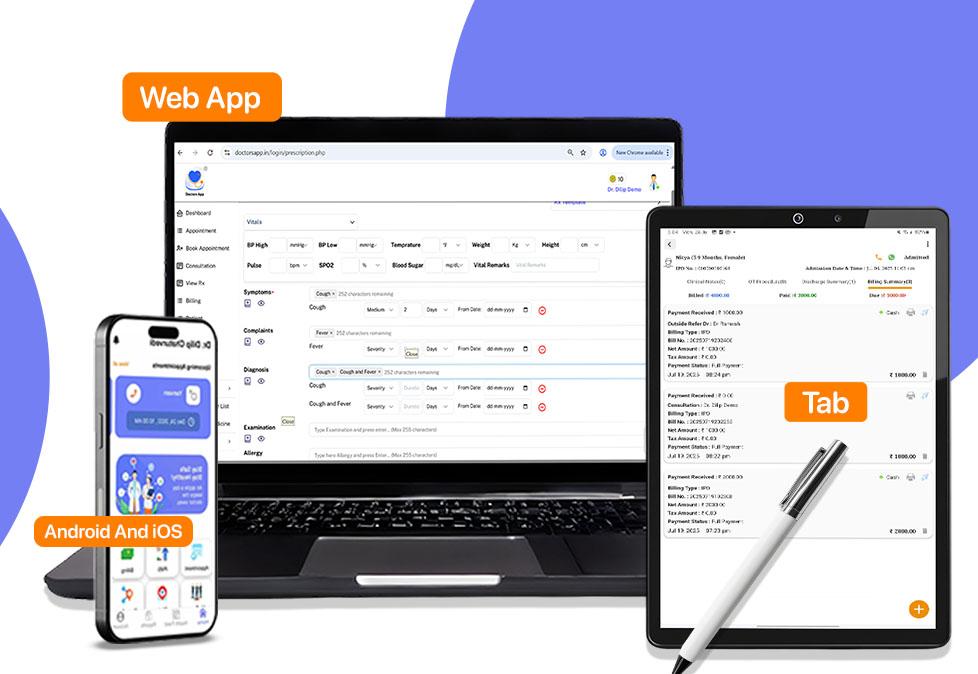
Doctors App is a digital healthcare platform designed to help doctors and healthcare facilities manage patient records, prescriptions, appointments and clinical operations. Orthopaedic doctors can evaluate it for managing routine consultations, patient histories, investigations, treatment documentation and follow-up visits.
Orthopaedic practices often manage patients with fractures, arthritis, back pain, joint disorders, sports injuries, ligament injuries and post-operative recovery needs. Maintaining a consistent digital record of each consultation can help doctors review previous visits and monitor a patient's treatment journey.
Key features to evaluate for an orthopaedic practice
-
Digital patient records: Maintain patient profiles, consultation history, medical details and previous prescriptions.
-
Digital prescriptions: Create and share prescriptions electronically instead of relying entirely on handwritten documents.
-
Appointment scheduling: Organise new consultations, follow-up visits and appointment slots.
-
Investigation management: Add investigation details and upload laboratory reports to patient records.
-
Clinical documentation: Record symptoms, diagnosis, treatment advice and follow-up instructions.
-
Billing and payments: Manage consultation billing and maintain clinic transaction records.
-
OPD management: Organise patient registration, consultations and daily outpatient workflows.
-
IPD management: Hospitals can evaluate inpatient workflows such as admission, clinical notes, nursing documentation, OT records and discharge summaries.
-
Mobile and web access: Access supported clinic information through available web and mobile applications.
-
AI-assisted documentation: Optional AI tools, such as AI Voice to Rx and report-reading capabilities, can help reduce repetitive documentation work. Doctors should review AI-generated information before approving it.
How can Doctors App help orthopaedic doctors?
An orthopaedic consultation may involve recording the patient's pain location, duration of symptoms, previous injuries, medical history, diagnosis, investigation results and treatment recommendations. A digital record system can help keep these details organised.
For example, when a patient visits a clinic for knee pain, the doctor can maintain the consultation details, add investigation information, record the prescribed treatment and document instructions for the next visit. During a follow-up, the doctor can refer to the previous record rather than searching through multiple paper files.
Orthopaedic clinics should confirm during a demo whether their preferred documentation templates support details such as fracture classification, joint examination, range-of-motion measurements, surgical history, implant information and rehabilitation progress. Do not assume that every specialty-specific template or imaging integration is included in the standard package. Machine or instrument integration, if required, should be discussed separately because it may be chargeable.
Doctors App for orthopaedic clinics and hospitals
Doctors App offers OPD/EMR plans for clinics and IPD/EMR solutions for hospitals. The hospital workflow can be useful for facilities that need to manage outpatient and inpatient activities through a connected system.
Its hospital-related capabilities include patient registration, ward and bed allocation, clinical notes, nursing notes, investigation history, OT documentation, discharge summaries and IPD billing. The exact features available depend on the selected plan and configuration.
Explore Doctors App:
Doctors App pricing
The published annual OPD/EMR clinic plans include:
|
Plan |
Annual price (excluding GST) |
|---|---|
|
Professional |
₹10,999 |
|
Premium |
₹16,999 |
An additional 18% GST applies. Optional features, integrations and add-ons may have separate charges. Hospital IPD/EMR pricing is available on request. Confirm the latest package details and inclusions before purchasing.
Best suited for: Orthopaedic doctors, private clinics, multispecialty clinics and hospitals looking for digital patient records with clinic or hospital management capabilities.
2. Drlogy – Orthopaedic Practice Management Software
Drlogy offers practice-management software for orthopaedic specialists. Its orthopaedic software is positioned around managing patient registration, appointments, OPD, IPD, billing and other clinic operations.
For orthopaedic doctors who want to organise their daily patient flow, a system combining clinical records and administrative workflows can be useful.
Key features to evaluate:
-
Patient registration and digital profiles
-
Appointment booking and queue management
-
Orthopaedic OPD management
-
IPD and OT management
-
Billing and payment management
-
Imaging and investigation reporting workflows
-
Laboratory and pharmacy management
-
Follow-up reminders
-
Staff access and role-based permissions
-
Multilingual templates
Drlogy also describes ready-to-use templates for orthopaedic practices. Doctors should check whether these templates match their clinical documentation requirements and whether the required features are included in their selected package.
3. HealthPlix – EMR Software for Orthopaedic Doctors
HealthPlix is an EMR platform for doctors that focuses on digital clinical documentation and prescription management. Orthopaedic specialists can consider it for maintaining patient records and managing routine outpatient consultations.
Orthopaedic doctors frequently need to review medical histories, previous prescriptions, investigation reports and treatment progress. Digital documentation can make this information easier to retrieve during repeat visits.
Key features to evaluate:
-
Electronic medical records
-
Digital prescription creation
-
Patient history management
-
Clinical documentation
-
Consultation records
-
Appointment-related workflows
-
Follow-up management
-
Doctor-focused digital tools
Before selecting HealthPlix, orthopaedic doctors should check whether the available templates can accommodate their preferred examination notes, injury histories, diagnosis details and post-treatment follow-up requirements.
Best suited for: Individual orthopaedic practitioners and clinics prioritising digital prescriptions and clinical record management.
4. Practo Ray – Clinic Management and EMR Software
Practo Ray is a clinic-management platform that combines patient records with administrative functions. It can be considered by orthopaedic doctors who want to manage appointments, consultations and billing through a digital system.
For a busy orthopaedic clinic, appointment organisation and easy access to previous consultation records can help improve the flow of routine work.
Key features to evaluate:
-
Patient registration
-
Appointment scheduling
-
Digital patient records
-
Prescription management
-
Consultation documentation
-
Billing and payment records
-
Patient follow-up
-
Clinic reports and administrative management
Orthopaedic clinics should check whether the system supports the level of clinical documentation they need. A general clinic-management platform may not automatically provide specialised fracture, joint examination or surgical documentation templates.
Best suited for: Independent orthopaedic doctors and outpatient clinics looking for general clinic-management capabilities.
5. Eka Care – Digital Health Records and EMR Platform
Eka Care provides digital health record and healthcare technology services. Its platform can be considered by orthopaedic doctors interested in maintaining digital patient information and exploring connected healthcare workflows.
Orthopaedic patients may visit multiple specialists, diagnostic centres and hospitals during their treatment. Organised digital records can help doctors review relevant information when it is available and shared appropriately.
Key features to evaluate:
-
Digital health records
-
Patient profiles
-
Prescription management
-
Medical history documentation
-
Consultation records
-
Patient-facing digital health tools
-
Connected healthcare workflows
-
ABDM-related capabilities, subject to the selected product and configuration
Doctors should confirm the precise EMR features, ABDM functions and integrations available in the package they intend to purchase.
Best suited for: Orthopaedic practitioners interested in digital health records and connected healthcare services.
6. MocDoc – Hospital and Clinic Management Software
MocDoc offers healthcare management solutions for clinics and hospitals. Orthopaedic facilities can evaluate it when they need to coordinate patient records with administrative and departmental activities.
For larger orthopaedic centres, managing outpatient consultations alone may not be enough. They may also need inpatient registration, billing, pharmacy, laboratory and other hospital workflows.
Key features to evaluate:
-
Patient registration and management
-
OPD management
-
IPD management
-
Electronic medical records
-
Billing and accounts
-
Pharmacy management
-
Laboratory workflows
-
Hospital administration
-
Department-level operations
Orthopaedic hospitals should ask for a demonstration of how the system handles surgical documentation, inpatient treatment records, discharge summaries and follow-up information.
Best suited for: Orthopaedic hospitals and larger healthcare facilities that require broader hospital-management capabilities.
7. Clinicea – Clinic EMR and Practice Management Software
Clinicea is a practice-management platform that clinics can evaluate for patient records and administrative workflows. Its suitability for orthopaedic specialists depends on how well its configurable documentation and clinic-management functions match their requirements.
Orthopaedic clinics that provide consultations, treatment planning and regular follow-ups need a system that can keep patient information organised across visits.
Key features to evaluate:
-
Patient record management
-
Appointment scheduling
-
Consultation documentation
-
Digital forms
-
Treatment and follow-up records
-
Billing and payments
-
Patient communication
-
Clinic administration
During a product demonstration, ask whether you can create custom clinical forms for musculoskeletal examinations, injury history, treatment plans and post-operative follow-ups.
Best suited for: Private orthopaedic practices looking for configurable clinic-management workflows.
8. KiviHealth – Clinic Management and Digital Records
KiviHealth is another option that clinics can consider when evaluating digital patient records and everyday practice-management tools.
For an orthopaedic practitioner, the ability to retrieve a patient's previous consultation details and maintain consistent follow-up records is important. A clinic-management system can help bring patient information and administrative activities together.
Key features to evaluate:
-
Patient management
-
Appointment scheduling
-
Digital prescriptions
-
Consultation records
-
Billing management
-
Follow-up organisation
-
Clinic reports
-
Staff and administrative workflows
Before purchasing, check the availability of specialty-specific documentation, data backup, record export and customer support.
Best suited for: Small and medium-sized orthopaedic clinics looking for digital practice-management tools.
9. DocPulse – EMR and Clinic Management Software
DocPulse is a clinic-management and EMR option that orthopaedic doctors can include in their software shortlist.
Managing patient visits digitally can help clinics organise appointments, prescriptions, consultation records and administrative information. This is particularly relevant for practices where patients return regularly for treatment reviews and recovery monitoring.
Key features to evaluate:
-
Patient registration
-
Electronic medical records
-
Appointment management
-
Prescription documentation
-
Consultation history
-
Billing workflows
-
Follow-up management
-
Clinic administration
Orthopaedic doctors should request a live demonstration of the consultation process and check whether the software can accommodate their required clinical notes and investigation records.
Best suited for: Outpatient orthopaedic clinics comparing general EMR and practice-management platforms.
10. MediXcel – EMR and Hospital Information Management Software
MediXcel is a healthcare technology solution associated with EMR and hospital information management. Orthopaedic hospitals and larger facilities can evaluate it when they need to manage patient information across multiple departments.
A hospital treating orthopaedic patients may need to coordinate consultations, diagnostic reports, admissions, surgical care, pharmacy, billing and discharge documentation. A broader hospital information system may support these operational requirements.
Key features to evaluate:
-
Electronic medical records
-
Patient registration
-
Clinical documentation
-
Hospital information management
-
Departmental workflows
-
Billing and administrative functions
-
Patient record access
-
Reporting and management tools
The exact modules and integrations should be confirmed with the provider, particularly if the hospital requires specialised orthopaedic workflows.
Best suited for: Multispecialty hospitals and larger orthopaedic facilities evaluating an integrated EMR or hospital information system.
Comparison Table: Top 10 Orthopaedic EMR Software in India 2026
The following table provides a practical shortlist. It is not an independently verified ranking of product quality. Each provider should be assessed through a live demonstration and a written feature and pricing proposal.
|
Software |
Best suited for |
Main capabilities to evaluate |
|---|---|---|
|
1. Doctors App |
Orthopaedic clinics and hospitals |
EMR, digital prescriptions, OPD, IPD, appointments, billing and clinical documentation |
|
2. Drlogy |
Orthopaedic clinics and specialists |
Orthopaedic practice management, OPD, IPD, imaging reports and billing |
|
3. HealthPlix |
Individual orthopaedic doctors |
Digital prescriptions and electronic patient records |
|
4. Practo Ray |
Outpatient clinics |
Appointments, patient records, prescriptions and clinic management |
|
5. Eka Care |
Digitally connected practices |
Digital health records, prescriptions and connected healthcare workflows |
|
6. MocDoc |
Orthopaedic hospitals |
EMR, hospital management, pharmacy and laboratory workflows |
|
7. Clinicea |
Private specialty clinics |
Patient records, configurable forms and clinic administration |
|
8. KiviHealth |
Small and medium-sized clinics |
Patient management, appointments and digital records |
|
9. DocPulse |
Outpatient practices |
EMR, prescriptions and clinic-management workflows |
|
10. MediXcel |
Larger healthcare facilities |
EMR and hospital information management |
Note: Orthopaedic-specific templates, imaging integrations, surgical modules, pricing and ABDM functionality are not necessarily included in every product or package. Confirm these directly with each provider.
What Is Orthopaedic EMR Software?
Orthopaedic EMR software is an electronic medical records system that helps orthopaedic doctors maintain patient information digitally. It can be used to record consultation details, medical history, examination findings, diagnosis, prescriptions, investigation reports and treatment progress.
Unlike a basic patient database, an effective EMR should support the clinical documentation process followed by orthopaedic specialists.
Orthopaedic doctors treat conditions involving bones, joints, muscles, ligaments, tendons and the spine. Their records may include injury details, pain assessment, physical examination findings, imaging reports, surgical history and rehabilitation instructions.
A suitable EMR should make it easy to organise these details and retrieve them during future consultations.
Why Do Orthopaedic Doctors Need EMR Software in 2026?
Orthopaedic practices manage patients with both short-term injuries and long-term musculoskeletal conditions. A patient with a fracture may require multiple consultations, investigation reviews and recovery assessments. A patient with arthritis may need ongoing treatment monitoring and periodic follow-ups.
Maintaining all this information manually can become difficult as the clinic grows.
Here are some important reasons to adopt orthopaedic EMR software.
1. Digital Management of Patient History
Patient history plays an important role in orthopaedic treatment. Doctors may need to review previous injuries, surgeries, medication details, chronic conditions and earlier treatment plans.
EMR software helps store these details in an organised digital record, making them easier to access during future consultations.
2. Better Consultation Documentation
Orthopaedic consultations often require detailed notes about symptoms, affected body parts, pain duration, mobility limitations and examination findings.
Digital documentation can help doctors maintain consistent records and reduce dependence on handwritten notes.
3. Easy Access to Investigation Reports
Orthopaedic patients may undergo X-rays, MRI scans, CT scans, blood tests and other investigations.
An EMR can help doctors record investigation details and keep uploaded reports associated with the patient's profile. If direct imaging or PACS integration is required, the clinic should verify its availability and any additional charges.
4. Digital Prescriptions
Doctors can create digital prescriptions and share them with patients through supported channels. This can reduce problems associated with unclear handwriting and misplaced prescription papers.
5. Improved Follow-Up Management
Many orthopaedic conditions require regular follow-up consultations. Patients recovering from injuries or surgeries may need periodic assessments.
Appointment scheduling and follow-up reminders can help clinics organise these visits.
6. Better Coordination Between Clinical and Administrative Teams
In a larger orthopaedic centre, doctors, receptionists, billing staff and other team members may need access to different parts of a patient's record.
Role-based access can help ensure that staff members see the information needed for their responsibilities.
7. Reduced Paperwork
Digital records reduce the need to maintain large collections of physical patient files. They can also make it easier to retrieve previous prescriptions and consultation details.
8. Better Clinic Administration
A clinic-management system can combine patient records with appointments, billing and reporting. This gives doctors and administrators a more organised view of daily clinic activities.
Important Features to Look for in Orthopaedic EMR Software
Not every EMR is designed for the same medical specialty. Orthopaedic doctors should consider the following features before choosing a platform.
1. Orthopaedic-Specific Clinical Templates
The software should allow doctors to document information relevant to musculoskeletal conditions.
Useful documentation fields may include:
-
Chief complaint and symptoms
-
Pain location and duration
-
Previous injury history
-
Affected joint or body part
-
Physical examination findings
-
Range-of-motion measurements
-
Diagnosis and treatment plan
-
Follow-up instructions
Customisable templates can make documentation more consistent and efficient.
2. Fracture and Injury Documentation
Orthopaedic clinics frequently treat fractures, dislocations, ligament injuries and sports-related trauma.
The EMR should allow doctors to record the injury mechanism, affected area, diagnosis, treatment details and follow-up findings.
3. Imaging and Investigation Records
X-rays, MRIs and CT scans are important in orthopaedic diagnosis and treatment planning.
The software should make it easy to associate investigation reports with the patient's digital record. Clinics that require direct PACS or imaging-device connectivity should ask the provider for a technical demonstration and a separate cost estimate where applicable.
4. Digital Prescription Management
A prescription module should support medication names, dosage, frequency, duration and instructions.
Doctors should also be able to review previous prescriptions when appropriate.
5. Surgical and Procedure Documentation
Orthopaedic hospitals and surgical centres may need to record:
-
Pre-operative assessments
-
Surgical history
-
Procedure details
-
Post-operative notes
-
Medication records
-
Discharge summaries
-
Follow-up recommendations
The availability of OT and surgical documentation should be checked for the selected software package.
6. Physiotherapy and Rehabilitation Follow-Ups
Recovery after orthopaedic treatment may involve physiotherapy and rehabilitation.
A useful system should allow doctors to record rehabilitation advice, follow-up observations and changes in the patient's condition. If a dedicated physiotherapy module is necessary, confirm whether it is available.
7. Appointment Scheduling and Reminders
Orthopaedic patients may need repeated visits for injury reviews, treatment monitoring and post-operative assessments.
Appointment management helps clinics organise schedules and reduce manual coordination.
8. Billing and Payment Management
Billing functionality can help clinics record consultation charges, procedures and other applicable services.
Hospitals may also require IPD billing, package management and insurance-related workflows.
9. Cloud Storage and Data Backup
Cloud-based EMR software can allow authorised users to access patient records through supported devices and locations.
Before selecting a provider, check its backup policies, data security practices, access controls and data-recovery process.
10. ABDM and ABHA Support
Indian healthcare providers may also evaluate whether their EMR supports relevant Ayushman Bharat Digital Mission workflows.
Ask the provider to demonstrate the specific ABDM milestones and functions required by the clinic, such as M1, M2 and M3 capabilities where applicable, along with ABHA creation, verification and consent-based health record sharing. These capabilities should not be assumed to be included in every package.
How to Choose the Best Orthopaedic EMR Software for Your Clinic
Choosing the right EMR requires more than comparing feature lists. Doctors should evaluate how the software performs during an actual consultation.
1. Understand Your Clinic's Requirements
Start by identifying the size of your practice and the type of services you provide.
A solo orthopaedic doctor may need patient records, prescriptions and appointment scheduling. A multispecialty hospital may require OPD, IPD, OT, pharmacy, laboratory and billing modules.
2. Check Specialty Customisation
Ask whether the software supports orthopaedic consultation templates. If not, find out whether you can create custom fields for injury history, joint examination, fracture assessment and recovery notes.
3. Evaluate Ease of Use
The software should be easy for doctors and clinic staff to use.
Ask the provider to demonstrate a complete patient journey, starting with registration and ending with prescription creation and follow-up scheduling.
4. Review Pricing and Additional Costs
Compare annual or monthly subscription costs and check what is included.
Ask about additional charges for:
-
Extra doctor or staff accounts
-
AI features
-
WhatsApp messaging
-
Laboratory and pharmacy modules
-
Imaging or PACS integrations
-
Data migration
-
Custom templates
-
Hospital or IPD modules
5. Check Data Security and Ownership
Patient information is sensitive. Review the provider's data protection practices, access permissions, backup policies and contractual terms.
Also confirm that you can export your clinic's records in a usable format if you decide to change software later.
6. Request a Live Demo
A live demo is one of the most useful ways to assess an EMR.
Test routine consultations, repeat visits, prescriptions, investigation uploads, billing and follow-up scheduling using realistic clinic scenarios.
7. Check Customer Support and Training
Implementation and staff training are important, particularly when a clinic is moving from paper records to a digital system.
Ask about onboarding, data migration support, training resources and response times for technical issues.
Benefits of Using Orthopaedic EMR Software
|
Benefit |
How it helps |
|---|---|
|
Organised patient history |
Makes previous consultations easier to review |
|
Digital prescriptions |
Simplifies prescription creation and sharing |
|
Faster record retrieval |
Reduces time spent searching for paper files |
|
Investigation management |
Keeps reports associated with patient records |
|
Follow-up scheduling |
Helps organise repeat consultations |
|
Reduced paperwork |
Supports a more organised digital workflow |
|
Better administration |
Connects clinical and administrative activities |
|
Reporting |
Helps clinics review operational information |
|
Role-based access |
Supports controlled access for different staff members |
|
Hospital workflow support |
Helps larger facilities coordinate OPD and IPD activities when available |
Orthopaedic EMR Software for Different Types of Practices
The right software depends on the type of orthopaedic practice.
EMR for Individual Orthopaedic Doctors
Individual practitioners may prioritise patient registration, consultation notes, digital prescriptions, appointment scheduling and follow-up records.
A simple, easy-to-use platform may be sufficient if the clinic does not require extensive hospital modules.
EMR for Orthopaedic Clinics
A growing clinic may need additional staff accounts, billing, patient communication, investigation records and reporting.
A combined EMR and clinic-management platform can help manage both clinical and administrative activities.
EMR for Orthopaedic Hospitals
Hospitals may need a more comprehensive system that supports outpatient and inpatient care.
Important requirements can include:
-
OPD and IPD registration
-
Clinical documentation
-
OT and surgical records
-
Ward and bed management
-
Nursing notes
-
Pharmacy and laboratory workflows
-
Discharge summaries
-
IPD billing
-
Insurance and TPA documentation
EMR for Joint Replacement and Surgical Centres
Facilities providing joint replacement and other orthopaedic procedures may need detailed pre-operative and post-operative documentation.
They should confirm whether the software supports procedure records, implant details, consent forms, recovery assessments and discharge documentation.
Frequently Asked Questions (FAQs)
1. Which is the best orthopaedic EMR software in India in 2026?
The best software depends on the clinic's requirements. Doctors App, Drlogy, HealthPlix, Practo Ray and other platforms can be considered. Orthopaedic doctors should compare clinical documentation, digital prescriptions, appointments, investigation management, pricing and specialty-specific features before making a decision.
2. What is orthopaedic EMR software?
Orthopaedic EMR software is a digital medical records system that helps orthopaedic doctors maintain patient histories, consultation notes, diagnoses, prescriptions, investigation reports and treatment records.
3. Can orthopaedic EMR software manage fracture patients?
An EMR can help doctors record fracture-related information such as injury history, affected body part, diagnosis, investigation details, treatment plans and follow-up observations. The availability of dedicated fracture templates depends on the software.
4. Does orthopaedic EMR software support X-ray and MRI reports?
Many EMR platforms allow doctors to add investigation details and upload reports. Direct integration with imaging equipment or PACS systems is a separate requirement and should be confirmed with the provider.
5. Can orthopaedic doctors create digital prescriptions?
Yes. Many EMR platforms provide digital prescription tools that allow doctors to record medicines, dosage, frequency, duration and instructions. Check the prescription customisation options before selecting a system.
6. Is cloud-based EMR software useful for orthopaedic clinics?
Cloud-based software can make patient records accessible to authorised users through supported devices and internet connections. Doctors should evaluate security, backups, access permissions and data portability before purchasing.
7. What is the difference between orthopaedic EMR and hospital management software?
Orthopaedic EMR focuses on clinical records, consultation notes, prescriptions and patient history. Hospital management software covers broader operational activities such as OPD, IPD, billing, pharmacy, laboratory, OT and administration. Some platforms combine both.
8. Can orthopaedic EMR software manage post-operative follow-ups?
An EMR can help doctors document post-operative consultations, recovery observations, prescriptions and follow-up schedules. Dedicated rehabilitation or physiotherapy modules should be verified separately.
9. Is orthopaedic EMR software suitable for small clinics?
Yes. Small orthopaedic clinics can use EMR software to organise patient information, manage prescriptions, schedule appointments and maintain consultation history without investing in a full hospital information system.
10. What should I check before purchasing orthopaedic EMR software?
Check clinical templates, prescription management, patient history, investigation uploads, appointment scheduling, billing, data security, data export, support, pricing and any additional integration charges.
11. Does Doctors App provide EMR software for orthopaedic doctors?
Doctors App provides EMR and clinic-management solutions that orthopaedic doctors can evaluate for digital patient records, prescriptions, appointments, investigation management and other clinic workflows. Doctors should confirm the availability of specific orthopaedic templates and integrations during a demo.
12. How much does orthopaedic EMR software cost in India?
Pricing varies according to the provider, number of users, selected modules and clinic size. Doctors App's published annual clinic plans include Professional at ₹10,999 and Premium at ₹16,999, excluding 18% GST. Optional features and hospital modules may have additional charges. Always confirm the latest quotation.
Conclusion: Choose the Right Orthopaedic EMR Software for Your Practice
Digital patient records are becoming an important part of modern orthopaedic practice management. From managing fracture histories and joint conditions to documenting prescriptions, investigation reports and follow-up consultations, EMR software can help doctors maintain organised clinical information.
The 10 platforms covered in this guide offer options for different types of healthcare practices. Some focus on digital prescriptions and outpatient records, while others provide broader clinic and hospital-management capabilities.
Doctors App is an option for orthopaedic doctors looking to manage digital patient records alongside clinic and hospital workflows. Its EMR platform can help organise consultations, prescriptions, appointments, investigations and patient information. Clinics should confirm specialty-specific templates, optional modules and integration requirements before selecting a plan.
Before making a final decision, request a product demonstration, compare the total cost and check whether the software fits your actual consultation process.
Explore Doctors App and book a free EMR demo:
-
Website: www.doctorsapp.in
-
Orthopaedic EMR: Doctors App for Orthopaedic Doctors
-
WhatsApp Free EMR Demo: +91 85917 52176
-
Email: [email protected]
Doctors App – Streamline Your Practice with Doctors App.